
The Tears-in-Rain Problem.
Why some things should dissolve. On the management systems that survive because nobody dares to question them.

Roy Batty’s dying monologue in Blade Runner is an elegy. He grieves what will dissolve with him into silence. The original emotion is sorrow.
I’ve seen things you people wouldn’t believe.
Attack ships on fire off the shoulder of Orion.
Performance dashboards worshipped like sacred texts.
I watched C-beams glittering in the dark near the Tannhäuser Gate.
Strategy decks so dense they collapsed under their own gravity.
All those moments — thankfully — lost in time, like tears in rain.
The organisational version inverts all of that. What is lost above is not sublime — it is bureaucratic sediment.
And the word that changes everything is the one inserted between the dashes: thankfully. Roy Batty mourned what dissolved. This version argues that some things should dissolve — and that their dissolution is not loss, but relief.
Not every management system deserves saving. Some were never about performance. They were about the appearance of rigour — the comfort of structure in the absence of clarity. The tragedy is not that they exist. It is that nobody has yet decided to let them go.
THE MECHANISM BEHIND THE DECAY
Entropy in physical systems is a law. In organisations, it is a tendency — but a powerful one. Performance management systems decay not because people stop caring, but because the measure gradually displaces the thing being measured.
Charles Goodhart observed this in monetary policy: once a measure becomes a target, it ceases to be a good measure. Every domain organisations touch has confirmed it since.
The sequence is familiar. A metric is chosen because it correlates with something that matters. Over time, people optimise for the metric rather than the underlying thing. The correlation weakens. The metric persists — because it is now embedded in review cycles, compensation structures, and board reporting. Nobody remembers why it was chosen. Nobody dares remove it.
This is not incompetence. It is institutional physics. Form, once established, resists displacement. What was once a diagnostic instrument become a ritual artefact.
INERTIA SYSTEMS VS. FUNCTIONING SYSTEMS
The distinction matters. But the test is not complicated.
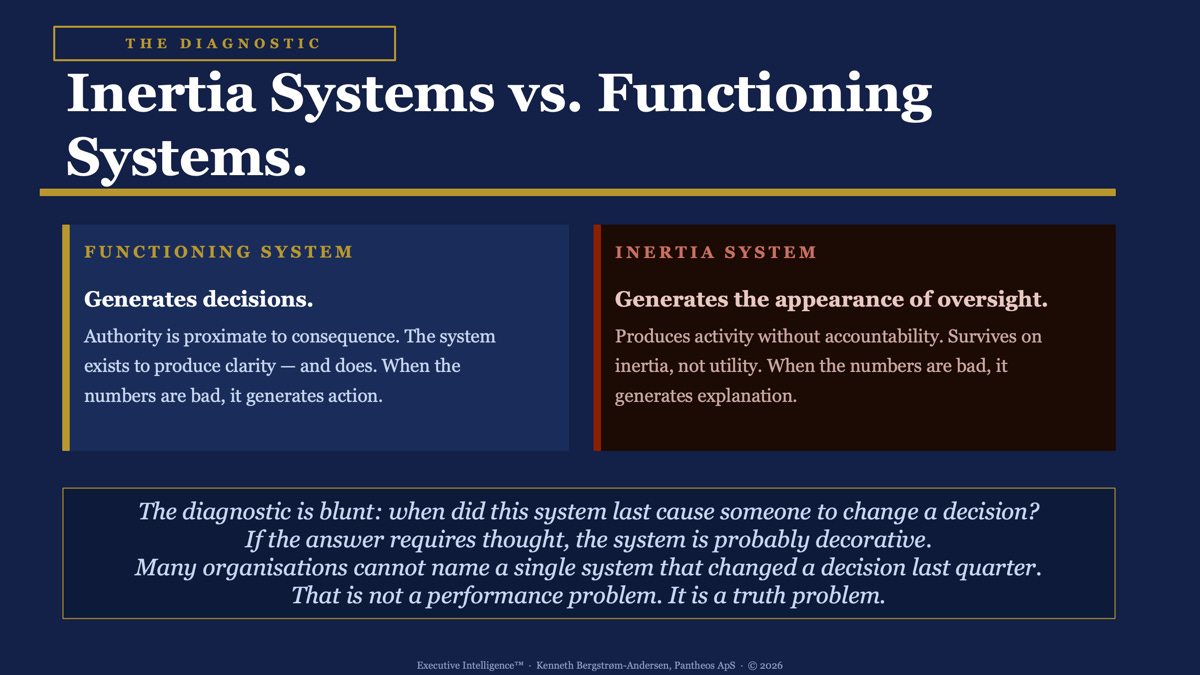
A functioning system generates decisions. An inertia system generates the appearance of oversight. The difference is not always visible in the design — but it is always visible in what happens when the numbers are bad.
The diagnostic is blunt: when did this system last cause someone to change a decision? If the answer requires thought, the system is probably decorative.
THE SYSTEM NOBODY DARES TO QUESTION
The most dangerous inertia systems are not the ones nobody noticed. They are the ones everybody can see — and nobody will touch.
These are the systems that were, at the moment of their creation, a genuine act of leadership. Someone designed them carefully. Someone fought for them. Someone used them, early on, to make a decision that mattered. That history is now embedded in the system’s survival — not because the system still works, but because removing it would implicitly question the judgement of the person who built it. In many organisations, that person is still in the room.
This is the deepest form of institutional inertia. Not the system that was always mediocre — but the system that was once excellent, and has been preserved as evidence of that excellence long after the excellence has gone. The organisation is not protecting the process. It is protecting the narrative.
Which is why the question that matters is not “does this system still work?” — but “what would it mean about the past if we admitted that it doesn’t?” That is a harder question. And it is the one that never gets asked.
WHAT DESERVES TO SURVIVE — AND BY WHAT CRITERION
The criterion is not simplicity. It is not modernity. It is not even accuracy, strictly defined.